
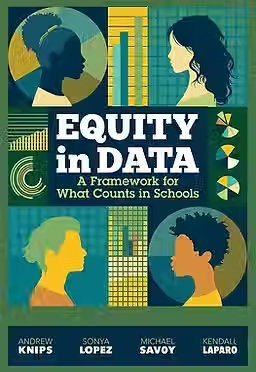
Create an equitable data culture in your school or district.
"Data is neither mystical nor magical. It is a tool along with many other tools in educators' hands. It can be used fairly or unfairly – justly or unjustly – equitably or inequitably. Equity in Data shows us how to make ethical, just decisions using data. This is an important book for all educators."
Dr. Gloria Ladson-Billings
University of Wisconsin
About the Book
Your students are not just statistics. They aren’t simply a set of numbers or faceless dots on a proficiency scale. They are vibrant collections of experiences, thoughts, perspectives, emotions, wants, and dreams. And taken collectively, all of that information is data—and should be valued as such.
Equity in Data not only unpacks the problematic nature of current approaches to data but also helps educators demystify and democratize data. It shows how we can bake equity into our data work and illuminate the disparities, stories, and truths that make our schools safer and stronger—and that help our students grow and thrive.
To this end, the authors introduce a four-part framework for how to create an equitable data culture (along with a complementary set of data principles). They demonstrate how we can rethink our approach to data in the interest of equity by making five shifts:
• Expand our understanding of data.
• Strengthen our knowledge of data principles.
• Break through our fear of data.
• Decolonize our data gathering processes.
• Turn data into meaningful, equitable action.
We have an opportunity to realign school data with what students want out of their educational experiences. When we put equity first, we put students first.


Equity in Data was a finalist for the 2023 Association & Media Publishing EXCEL Awards
Meet the Authors

Andrew Knips
Andrew Knips (he/him) has 15+ years of experience teaching students, leading teams, and coaching leaders in Philadelphia’s public, alternative, and charter schools. He is an education leadership coach, executive coach, data consultant, and racial literacy trainer. Previously, he was a high school English teacher and school administrator. Andrew has observed thousands of teacher team and leadership team meetings, facilitated hundreds of professional learning sessions, coached hundreds of educators, and collaborated on equity audits in over a dozen
schools and organizations. He also designs data tools and systems for schools. Andrew has a BA in political science, international studies, and Latin American studies from the University of Wisconsin–Madison, an MSEd in urban education from the University of Pennsylvania, and a K–12 principal certification from Temple University.

Sonya Lopez
Sonya Lopez (she/her) is currently a school-based social worker in Philadelphia. She has worked for more than a decade in schools in a number of roles, including language arts and literature teacher, school administrator, and director of social-emotional learning at a K–12 charter school. Across settings, her approach to practice supports a contextual understanding of individual experiences through a systems lens and a holistic perspective of identity. Throughout her career, Sonya has collaborated with clinicians, therapists, creatives, educators, and families in Philadelphia to shape environments informed by understanding mental health, resilience, sociopolitical contexts, trauma, and grief. She holds a BA in English literature from Villanova University, an MSEd in education, and an MSW with a clinical concentration from the University of Pennsylvania.

Dr. Michael Savoy
Dr. Michael Savoy (he/him) has 25 years of educational experience, including teaching mathematics at the middle school, high school, and college levels; working with community organizations on school policy, advocacy, and involvement; and working with K–12 teachers, teacher leaders, and administrators to improve the equitable education experiences and opportunities for all their students. Throughout his educational career, he has continued to focus on ways to dismantle educational inequities, improve educational environments, and involve more parent and community stakeholders in the success
of all students. He is the author of several journal articles and book chapters on educational change. Dr. Savoy earned his bachelor’s degree in aerospace engineering from the University of Maryland, his master’s degree in mathematics education from Salisbury University, and his PhD in instructional systems design from Pennsylvania State University.

Dr. Kendall LaParo
Dr. Kendall LaParo (she/her) is an education researcher and sociologist who studies inequality in school systems. She is a quantitative researcher at Research for Action, an education research firm in Philadelphia. She cofacilitated Philadelphia’s Data & Assessment Community of Practice, a gathering space for education leaders. Kendall began her career as an elementary school teacher in Camden, New Jersey. While teaching, she discovered a passion for education research and now uses her experience as an educator to inform her data science work. She served as director of analytics at education nonprofit Springboard Collaborative, where she managed data collection and analysis for three national out-of-school-time literacy programs that served more than 5,000 students each year. She also worked as a researcher at the School District of Philadelphia and Temple University’s Public Policy Lab. She holds an MS in urban education from the University of Pennsylvania and a PhD in sociology from Temple University.
